
Updated:
I’ve got my SPL licence – what next?
Now comes the most interesting bit: you’ll be progressing along two paths simultaneously – the class of gliders the club entrusts you with, and the distance you can fly from your home airfield into the mountains.
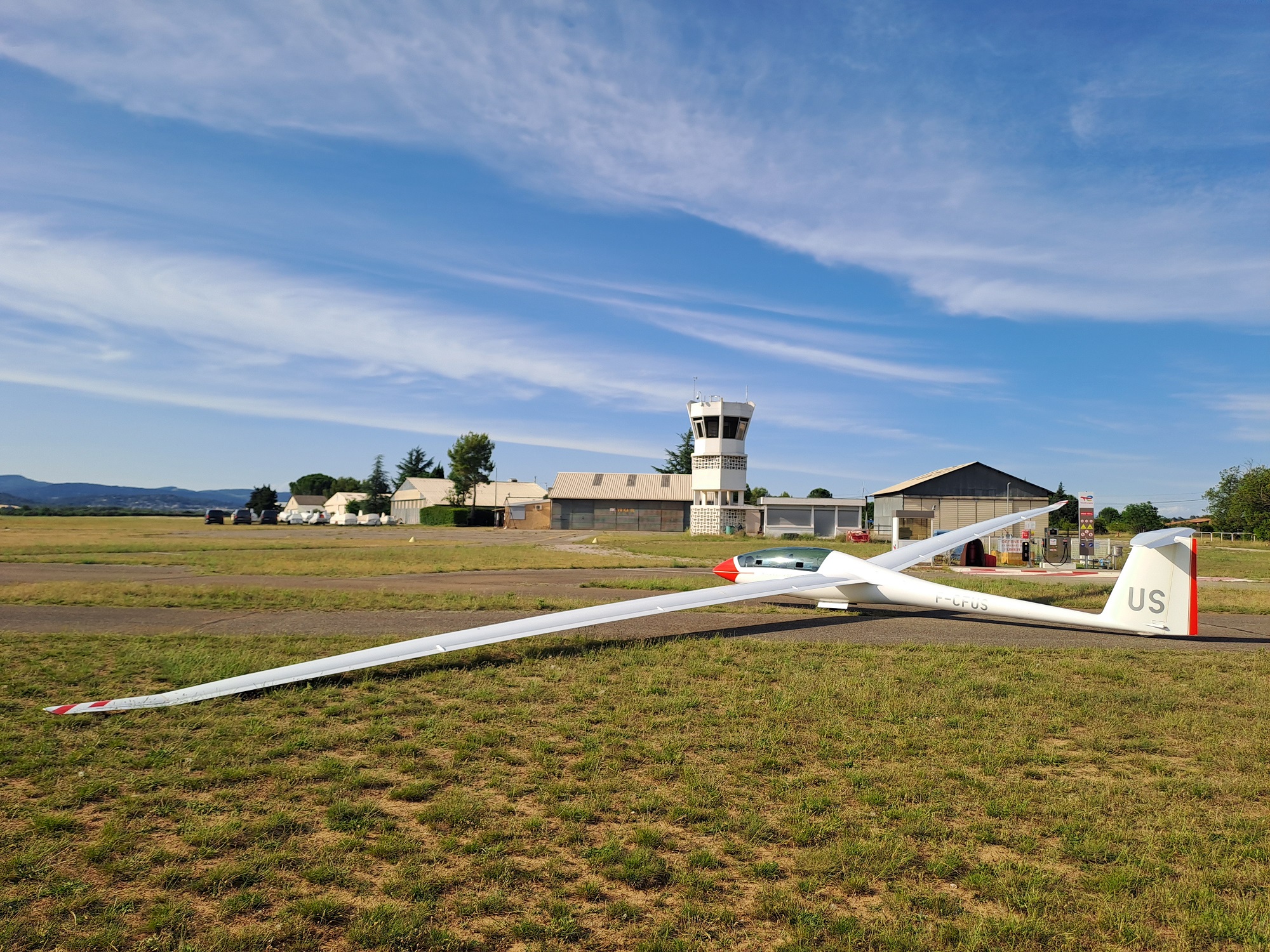
You’ll spend your first 10 hours as pilot-in-command aboard a single-seater Schleicher ASK23 glider. This is followed by a briefing on the 15-metre fixed-wing Rolladen-Schneider LS4 glider and 100 hours of flight time.
Once you have completed your first 100 hours of flight time, you are eligible to fly the first 18-metre glider of your flying career: the LS8. Although it too will be without controllable flaps, it is already a fully-fledged sports glider. Thirty hours on the 18-metre LS8 open the door to the world of flapped gliders.
A briefing and a few flights with an instructor on a glider with flaps, and you’ll be authorised to fly the 18-metre flapped gliders: the Schempp-Hirth Ventus 2, the LS6 and the Jonker JS3. At each stage, one of the club’s instructors takes responsibility for clearing you to fly a new type of glider.
When using the club’s gliders, you are restricted to certain flight areas, known as zones: T0, T1, T1+, T2 and T3. These are nested within one another, like Russian dolls. Zone T0 is automatically granted to you upon passing your licence exam. You gain access to the subsequent zones as your flying experience grows. The procedure is the same as for flight training: on the GESASSO portal, your instructor opens a training programme for you and makes notes during each session – noting what you have mastered and what is still in progress – whilst tracking your progress on each point. Your flight tracks are also uploaded there.
None of this applies to you if you own your own glider. In that case, the only limit is your own common sense. The licence you have obtained is valid in all EASA countries; in other words, you can fly freely throughout Europe and in countries that have joined EASA (see list) . In other countries, your licence can be validated (a procedure to recognise your licence) or converted (a local licence is issued to you on the basis of your licence).
There is another avenue for progression: removing restrictions and extending your SPL licence. For example, removing the restriction on carrying a passenger (PAX) requires 10 hours of solo flight time after obtaining the licence or 30 take-offs and landings. The TMG (Turbine-powered Motor Glider) rating requires 6 hours of flight time, 4 of which must be with an instructor, and a solo flight of at least 150 km with a landing at another controlled aerodrome. The TMG rating will enable you to commence training for the LAPL (Light Aircraft Pilot Licence) without having to sit the theory exam.
And with 200 take-offs and landings and 100 hours of flight time, you can start training to become a Flight Instructor (FI); however, in addition to the financial requirements, you will need to obtain two letters of recommendation: one from the president of your club and one from the chief pilot.