
Updated:
What does glider pilot training involve?
Practical training consists of two sessions, each lasting two weeks. The first session focuses exclusively on flights in the vicinity of the airfield, covering the 18 lessons of the standardised training programme set by the French Gliding Federation (Module 1). Take-off and landing, practising flying behind a tow plane, basic radio communication, and checklists.
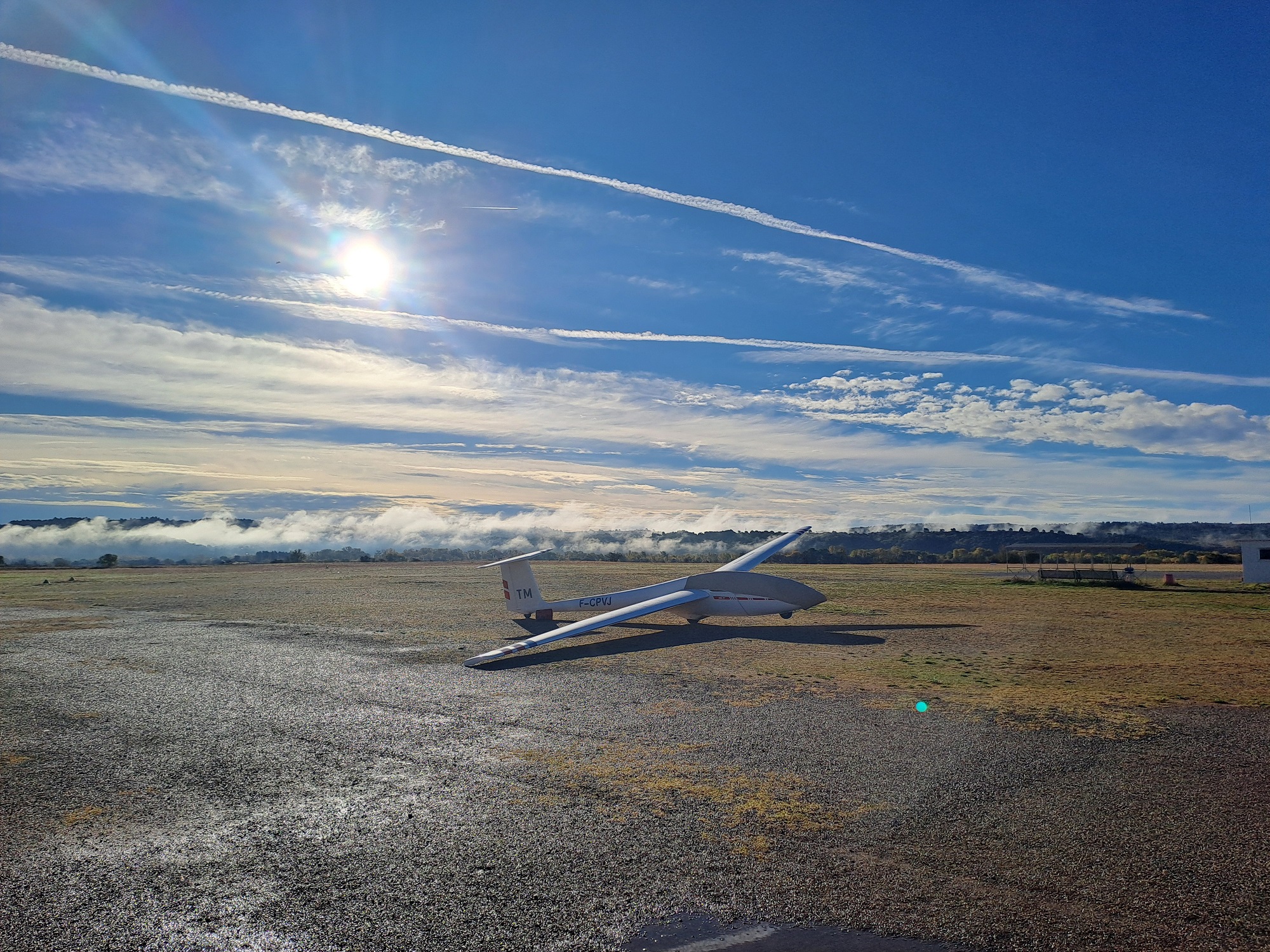
The aim is to get you flying solo. The vast majority of people are able to fly solo after 11–13 hours of training flights with an instructor. During this phase of flight training, your flights are short: 45 minutes maximum. Circling flights are even shorter: 5–7 minutes. The training is a mix of activities: a briefing in the morning, followed by simulator training (saving you money on towing: 35–40 euros per tow). After lunch – training in a two-seater Schleicher ASK21 glider with an instructor.
The second two-week session covers the cross-country part of glider training (modules 2 and 3). You will already be able to take off independently behind a tow plane, conduct radio communications and land the glider safely at the airfield. The aim of the cross-country phase is to teach you how to stay airborne and navigate in the glider whilst flying beyond the vicinity of your home airfield. And most importantly – to return safely. By the end of Module 3, you will have completed your first solo cross-country flight of 50 km, and, together with your instructor, you will have flown your first genuine mountain cross-country routes of over 100 km. The main glider used is the Schempp-Hirth Duo Discus.
The aim of the second session is to prepare you for the practical exam for the SPL glider pilot’s licence by developing your seven competencies (Knowledge, Flying Skills, Procedures, Communication, Situational Awareness, Workload Management, Decision-making).
This is perhaps the most interesting part of the training: you’ll learn to gain altitude by flying spirals in thermals, utilise dynamic air currents along mountain slopes, and make use of atmospheric convergence. You might even be lucky enough to encounter an atmospheric wave.
Navigation and range calculation are another important part of route training. You will learn to calculate the altitude required for a safe flight to aerodromes or landing sites along your route. You will be able to read aeronautical charts whilst understanding airspace restrictions, and conduct a simple dialogue with air traffic controllers. You will learn the terminology used in radio communications. One of the sessions will be devoted to selecting landing sites from the air. On a motor glider (TMG), we will examine the most important landing sites and aerodromes, simulating a landing approach.
Theory training (Ground School) is left to you to complete independently. You may use the famous ‘Blue Book’: *Manuel du pilote vol à voile*, or the detailed online course to prepare for the SPL theory exam (the FFVP e-learning module). The DTO organisation where you are undertaking your practical training is authorised to conduct the exam; in our case, this is the AAVA club. Passing the theory exam (with more than 75 per cent correct answers) grants you admission to the practical exam. This is precisely why the most successful students begin their theory preparation even before arriving in Vinon. You can combine practical sessions with sitting the modules of the theory exam, as the modules (subjects) can be taken separately.